
By Justin Low | Serving Lake, Marion, Sumter, Citrus, Orange, Osceola, Seminole, Volusia, and Alachua Counties
Gate types in Central Florida matters as much as the operator running it — getting that decision right from the start saves you years of headaches. Install the wrong configuration for your site and you’ll spend the next several years fighting it — clearance problems, alignment issues, hardware failures, and gates that struggle in conditions they were never built for. This guide breaks down the main gate types, what each one actually requires, and where each one makes sense.
Swing Gates: The Most Common Choice — and the Most Misunderstood
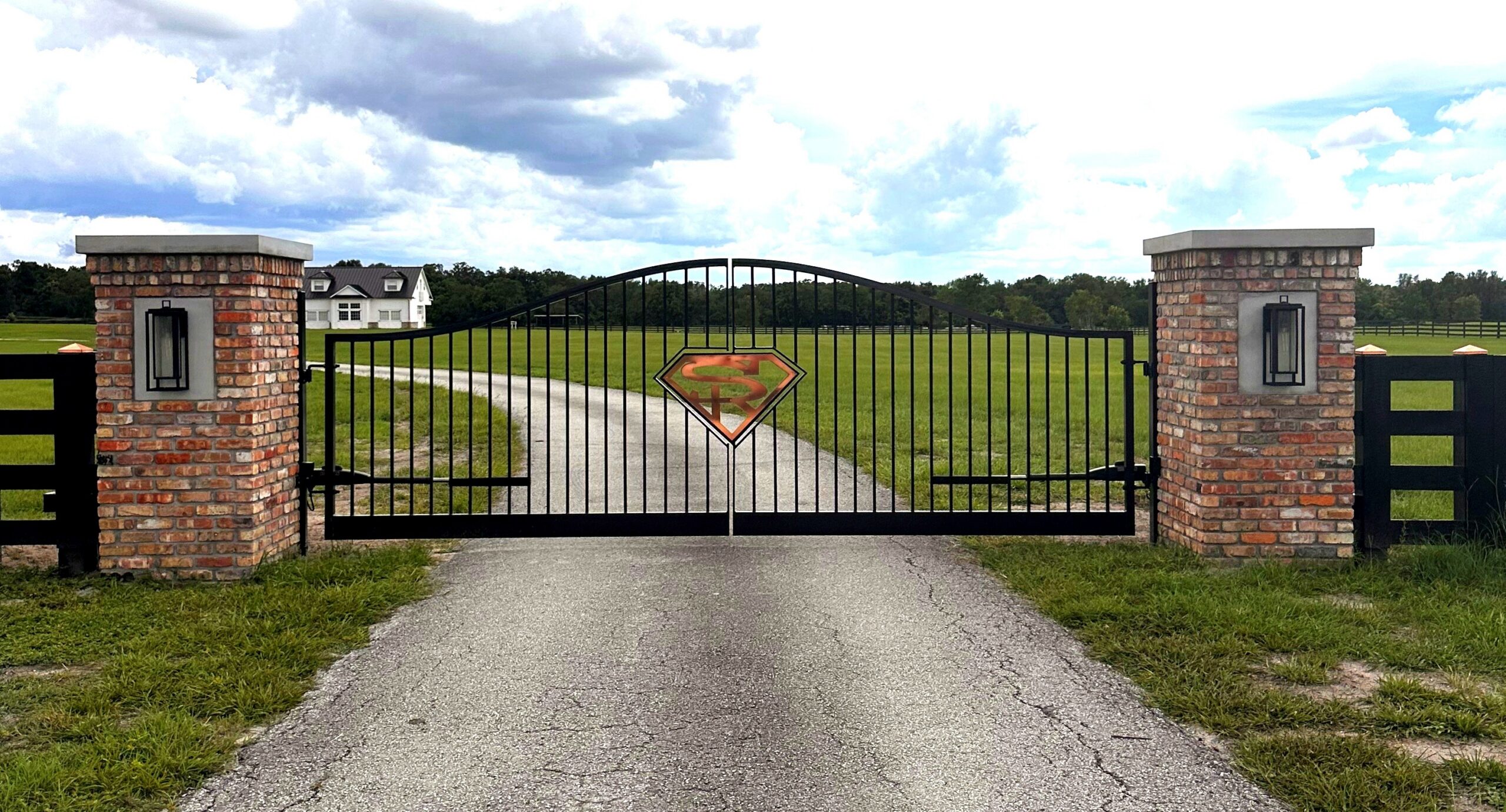
Swing gates are what most people picture when they think of an automatic gate. One or two panels hinged at a post, opening inward or outward. They’re widely used for residential driveways and lighter commercial applications.
What most people don’t think about before committing to a swing gate is arc clearance. Each panel needs unobstructed space to travel through its full range of motion. Inward-swinging gates need clear space on the interior side of the fence line — a slope, a landscaping feature, or a drainage ditch in the wrong place will stop the installation before it starts. Outward-swinging gates avoid that problem but require sufficient setback from the road.
Hinge post condition is another factor that gets overlooked. A swing operator puts real torque on the hinge post. If that post isn’t properly set in concrete and sized for the gate’s weight, the whole system will drift and fail prematurely. Post condition should be evaluated before anything else.
Swing gates work well for: residential driveways, farm entrances, estate properties with adequate arc clearance.
Sliding Gates: The Right Call When Space Is the Constraint
A sliding gate travels laterally along the fence line rather than swinging. Where there’s no room for arc clearance — a steep driveway, a tight entry, a property close to a road — a sliding gate is often the only workable option.
The requirement here is track space. The gate needs a clear run along the fence equal to at least the gate’s own width, plus room for the operator and any hardware. A 14-foot gate needs roughly 14-plus feet of lateral clearance to park when open. That space has to be level, unobstructed, and stay that way.
Sliding gates are generally more reliable in demanding-use environments. The mechanics are straightforward, duty-cycle ratings tend to be higher, and there are fewer variables than a swing gate dealing with wind load on an extended panel. For high-traffic commercial entries, a properly spec’d sliding gate is often the better long-term investment.
One common mistake: undersizing the motor for gate weight. A heavy steel sliding gate needs an operator matched to it. Manufacturers publish weight ratings — those aren’t suggestions.
Sliding gates work well for: sloped or constrained entries, commercial and industrial facilities, high-traffic applications.
Cantilever Gates: Sliding Without the Ground Track
A cantilever gate operates on the same lateral principle as a standard sliding gate but doesn’t rely on a ground track. Instead, the gate is suspended from rollers mounted on posts and cantilevered out over the opening. Nothing touches the ground.
This matters in applications where a ground track isn’t practical — gravel or uneven surfaces, areas with heavy debris or standing water, or any site where track maintenance would be a constant problem. Cantilever designs are also easier on the hardware overall since there’s no track to fill with dirt, rocks, and Florida’s abundant organic material.
The tradeoff is that a cantilever gate needs to be longer than the opening it covers — typically 1.5 times the opening width — to balance correctly on the rollers. That requires more fence line space than a standard slider.
Cantilever gates work well for: agricultural properties, gravel driveways, industrial yards, anywhere ground tracks are impractical.
Barrier Arm Gates: Access Control Over Vehicle Access
Barrier arms — the horizontal arm that raises and lowers — aren’t designed to stop unauthorized vehicles. They’re designed to manage authorized traffic flow. Parking facilities, HOA entries, commercial loading areas, apartment communities. The barrier arm signals “stop here, identify yourself” rather than providing physical security.
They’re fast, high-cycle, and cost-effective for applications where throughput matters. A well-spec’d barrier arm operator can handle hundreds of cycles per day. They also fail gracefully — in a power outage or malfunction, the arm can typically be raised manually without blocking traffic.
If the goal is physical security and vehicle deterrence, a barrier arm isn’t the answer. If the goal is access management at a controlled entry point, it’s often exactly the right tool.
Barrier arms work well for: parking facilities, HOA and apartment entries, commercial loading docks, anywhere access management is the priority over physical security.
What Florida Specifically Adds to Every One of These Decisions
Regardless of gate type, Central Florida’s environment introduces factors that don’t apply everywhere else.
Humidity and salt air (particularly as you get closer to the coasts) accelerate corrosion on hardware, hinges, and operator components. Every installation should use properly rated hardware — not standard hardware that happens to be installed outdoors. Conduit selection matters. Enclosure ratings matter.
Wind load is a real consideration, especially on wider swing gate panels. A large double-swing gate in an open area acts like a sail in a storm. That load goes directly into the hinges and the operator. Gates in exposed locations should be engineered accordingly.
Solar-powered operators are a genuinely viable option in Florida given the sun exposure, but battery sizing needs to account for cloudy stretches and high-cycle periods. Undersized battery banks are one of the most common failure points on solar gate installations.
None of these are reasons to avoid any particular gate type. They’re reasons to install it correctly from the start.
The Right Gate Starts with a Site Evaluation
The gate type that makes sense for your property depends on your specific site — topography, traffic volume, clearances, power availability, and how you intend to manage access. What works on a flat residential driveway is a different answer than what works on a commercial entrance cycling a hundred times a day.
Smart Entry Solutions assesses every site before specifying equipment. If you’re trying to figure out what makes sense for your property, give us a call at (352) 910-0013 or submit a Request a Quote and we’ll walk through it with you.