
What Happens to Your Gate Operator During a Power Outage (And How to Fix It)
Central Florida storms don’t ask permission before they knock out power. A gate operator power outage is one of the most common calls we get once the wind dies down, and it’s almost always preventable. Most gate operators have no idea a storm is coming and no way to keep working once the grid drops. That’s not a flaw in the equipment. It’s just how the vast majority of systems are built unless someone specifically planned around it.
Most Gate Operators Have No Power Source of Their Own
A standard gate operator runs on regular household electricity, stepped down through a transformer to feed the motor, the control board, and the safety sensors. Cut the power at the street, and the operator goes dark with it. There’s no fuel reserve, no internal charge, nothing. The gate stops wherever it happened to be when the lights went out, open or closed, and stays there until the grid comes back or someone intervenes.
This is the default, not the exception. Battery backup and solar charging exist precisely because the standard setup has no answer for an outage on its own. Unless backup power was specified at installation, it isn’t there.
Lake, Marion, Sumter, and Citrus County homeowners deal with this more than most. Florida’s storm season isn’t an occasional inconvenience, it’s a recurring planning problem. A gate that won’t open during an outage means a car stuck in the driveway. A gate that won’t close means a property sitting unsecured until the power crew shows up, which during a major storm can take days.
A Stuck Gate Has a Manual Release, and Forcing It Is a Mistake
A gate operator power outage doesn’t have to mean a stuck gate, though. Nearly every swing and slide gate operator includes a manual release lever or key, usually right on the operator housing. It disengages the motor so the gate can be pushed or pulled by hand. Find that release before you do anything else.
Check the breaker panel too. Sometimes the operator is fine and a tripped breaker is the entire problem, no outage required.
What you shouldn’t do is force a gate that’s still mechanically engaged with the motor. That’s how a five-minute outage turns into a damaged gearbox and a real repair bill. Most operators use a worm-gear or screw-drive mechanism that isn’t designed to be backdriven under load, so pushing against an engaged motor doesn’t just strain the gate, it can strip the internal gearing outright. The manual release exists specifically to take that load off before you push.
If you can’t locate the manual release, that’s a phone call, not a guessing game. Every brand handles disengagement a little differently. Some use a key-operated clutch, others a simple pull-lever under a cover plate, and a few require a specific sequence to avoid tripping a safety lockout. Walking someone through it over the phone usually takes two minutes once we know the brand.
A Gate Operator Power Outage Has One Real Fix: Battery and Solar Backup
A manual release gets you through one outage. It doesn’t fix anything. The actual fix is making sure the outage never reaches the gate to begin with.
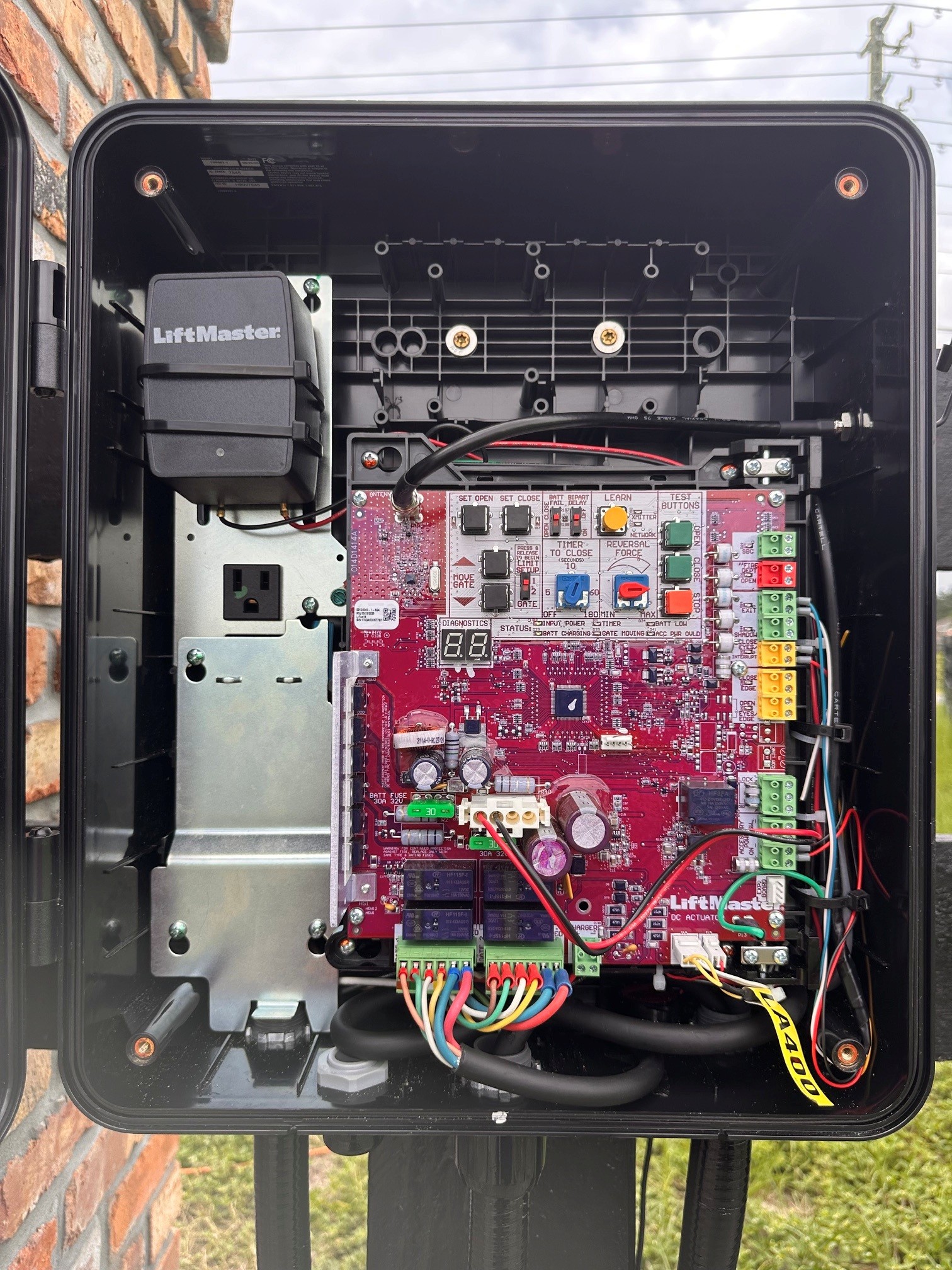
Battery backup sits between the operator and the main power feed and switches over automatically the moment the grid drops. A properly sized residential system can typically run a gate through dozens of open-and-close cycles on battery alone, which covers most Florida outages without the homeowner ever noticing a thing changed.
Solar takes it further. A panel keeps the battery topped off continuously, so the gate runs independent of the grid entirely rather than just bridging a gap. This matters most on rural or large-acreage properties across Marion and Sumter County, where running new electrical service out to a gate can cost more than the gate itself.
Both retrofit onto existing operators in most cases. This isn’t new-installation-only equipment. The hardware is a sealed deep-cycle battery sized to the operator’s draw, a charge controller to manage the handoff between grid, solar, and battery, and in most cases a single service visit to install it. No rewiring the property. No replacing the operator.
One thing worth knowing before that visit: not every operator fails the same way mid-cycle. Some stop in place. Others are wired to default open or closed depending on how the safety circuit is set up. This isn’t just a convenience question, either. UL 325 requires every gate operator to have a manual means of operation during a power failure, and a backup system has to preserve the same entrapment-protection behavior as grid power, not just keep the motor running. Ask whoever installed your gate which one yours does, or have it checked at your next service call.
Backup Power During a Gate Operator Power Outage Lasts Only as Long as the Battery Capacity Allows
This is the question we hear most, and “it depends” is the honest answer, but it depends on specific, knowable things. A gate cycling ten times a day drains a battery faster than one used twice, since backup capacity is rated in cycles, not hours. Slide operators draw more per cycle than swing operators of similar size, simply because they’re moving more mass. And like any battery, capacity degrades with age. A backup battery installed three years ago won’t run like it did on day one, which is exactly what an annual service check is for.
A properly sized residential battery should comfortably get a gate through a multi-day outage at normal use. Add solar, and the runway stops being a countdown at all, since the panel keeps replacing what the battery spends. That’s part of why we spec solar more often for the rural Marion and Sumter County properties that tend to wait longest for a utility crew after a major storm, where a fixed battery alone might not stretch as far as the outage does.
Works well for: gates that cycle frequently and need a battery sized above the bare minimum, properties where a service technician can check battery health annually rather than guessing at it, and anyone who’s already had a backup battery die quietly without warning.
Florida Specifically Adds a Storm Season That Doesn’t Care About Convenience
Hurricane season here isn’t a once-a-year event to plan around. It’s a recurring operating condition. A gate that fails open during a mandatory evacuation is a security problem. One that fails closed when a family needs to leave is worse. Properties across our service area, from Volusia to Osceola County, run into this exact scenario every storm season, not as a rare edge case but as something that’s going to happen again.
If you’re trying to figure out which gate type fits your property, or want the basics on what a gate operator actually does, those guides cover the ground floor. This one is about making sure whatever you pick still works when the power doesn’t.
Works well for: homeowners who’ve already had a gate fail during an outage, rural properties without easy access to grid power, and anyone planning ahead of storm season rather than reacting to it.
We Build Backup Power Into the Conversation, Not as an Afterthought
When we install or service a gate operator, battery and solar backup come up as part of the initial conversation, not as an upsell after something fails. We’ll walk through what fits your property, your operator, and how often your specific area tends to lose power.
If your gate is currently dead during outages, or you’d rather know your options before the next storm than after, reach out. We serve Lake, Marion, Sumter, Citrus, Orange, Osceola, Seminole, Volusia, and Alachua Counties.
Call (352) 910-0013 or use our contact page to get started.